Top 5 AI Video Generators in 2026 — Best AI Models for Video Creation
A roundup of the best AI video generators in 2026. Compare Seedance, Kling, Sora, Runway, Veo, and other AI models for TikTok, YouTube, advertising, and cinematic videos.

Share
AI video generation is no longer an experimental technology in 2026. Today, neural networks can create commercials, TikTok and Reels content, cinematic videos, music clips, and even movie previsualizations without a full production shoot. More and more creators, marketers, and studios are shifting from traditional production to generative video because it’s faster, cheaper, and allows ideas to be tested almost instantly.
Over the past few years, the market has changed dramatically. Instead of a handful of simple text-to-video models, we now have full-scale AI platforms with support for multi-shot scenes, character consistency, audio generation, camera control, and advanced prompting. As a result, choosing the right tool has become much more challenging.
In this article, we’ll break down the best AI video generators in 2026, compare their capabilities, strengths, and ideal use cases.
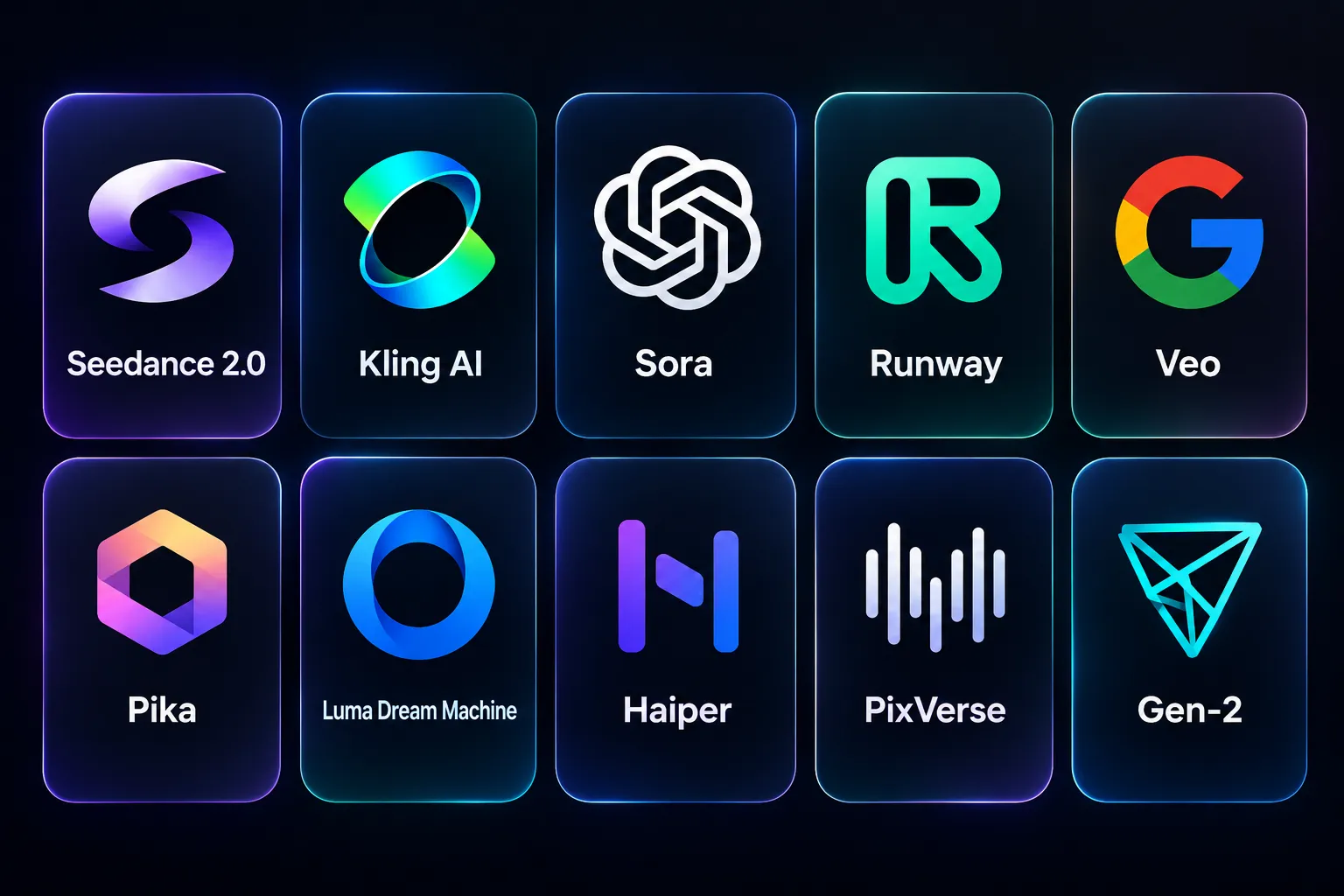
Seedance 2.0 is one of the most talked-about AI video generation models in 2026. The model quickly gained popularity thanks to its high-quality cinematic videos, support for multi-shot scenes, and strong control over video dynamics.
The key feature of Seedance 2.0 is its multimodality. The model can work not only with text, but also with images, video, and audio, allowing for more stable and predictable results.
Seedance performs especially well in:
TikTok and Reels content, advertising, cinematic videos, storytelling, music videos, and scene previsualization.
It’s also worth highlighting its impressive handling of atmosphere, lighting, and camera movement. That’s why Seedance 2.0 is often used for visually complex scenes.
Pros:
- high generation quality
- strong cinematic visuals
- multi-shot support
- excellent camera motion handling
- support for references and Elements
Cons:
- short generation length
- requires well-written prompts
- complex scenes often need to be assembled from multiple clips
- pricing/cost
Kling AI
Kling AI is one of the strongest AI models for realistic video generation. Unlike many models that focus on stylization or “wow visuals,” Kling primarily aims to preserve natural motion and realistic scene physics. That’s why its videos often feel more lifelike and less obviously AI-generated.
The model performs especially well with character movement, camera work, and long smooth scenes. Kling tends to produce fewer harsh animation artifacts, and motion transitions usually look more logical and consistent. This is particularly noticeable in scenes involving walking, turning, hand movements, or interaction with the environment — areas where many AI video models tend to break down.
At the same time, Kling also has limitations. Compared to Seedance 2.0, the model offers less direct control over the scene: it’s harder to manage multi-shot logic, action sequencing, and the structure of long-form videos. In addition, generation can take longer, especially for complex scenes with a lot of motion and detail.
Pros:
- very strong motion physics
- smooth and natural animation
- high level of realism
- powerful image-to-video generation
- high-quality long camera movements
Cons:
- less control over scene logic and storytelling
- more difficult to create multi-shot videos
- generation can be slower than competitors
- less suitable for complex “directed” content
HappyHorse 1.0
HappyHorse 1.0 is one of the most interesting AI video generation models in 2026. Its key feature is simultaneous video and audio generation, which makes videos feel more cohesive while improving lip-sync and the overall atmosphere of the scene. The model supports text-to-video, image-to-video, and audio references, providing a solid level of control over the final result.
HappyHorse performs especially well for cinematic videos, music videos, and ads with a strong focus on atmosphere and sound. At the same time, the model still requires high-quality prompting and references: complex scenes may suffer from character consistency issues, and longer videos are usually created through multiple generations and continuation workflows.
Pros:
- simultaneous video and audio generation
- very high-quality lip-sync
- strong cinematic presentation
- support for text, image, video, and audio inputs
- excellent atmosphere and lighting quality
- strong multi-shot potential
Cons:
- still requires advanced prompting
- long scenes often need to be assembled from multiple generations
- possible character consistency issues
- parts of the ecosystem and toolset are still evolving
Google Veo
Google Veo is one of the most technologically advanced AI video generation models. The model places a strong emphasis on realism, image quality, and cinematic presentation. Veo performs especially well with lighting, scene depth, and smooth camera movement, which is why its videos often look closest to real film production.
Veo is frequently compared to Sora because both models are designed not just for generating short clips, but for creating visually cohesive cinematic scenes. The model excels in environment shots, atmospheric visuals, and complex camera fly-throughs where composition and realistic motion are essential.
Pros:
- extremely high image quality
- excellent lighting and atmosphere rendering
- realistic camera movements
- cinematic-level visuals
Cons:
- more complex workflow
- not the fastest rendering speed
- requires strong prompting for stable results
Grok Video
Grok Video is xAI’s video generation model focused on fast creation of realistic and dynamic videos. The model emphasizes natural motion, atmospheric scenes, and a user-friendly workflow, making it a popular choice for short cinematic videos, TikTok/Reels content, and viral AI clips.
Pros:
- fast generation speed
- good realism
- strong image-to-video capabilities
- smooth camera movements
- video generation with audio support
Cons:
- weaker control over multi-shot scenes
- short video length
- instability in complex generations
- fewer tools for advanced workflows
Which AI model should you choose for video generation in 2026?
Each model in this list has its own strengths: Seedance 2.0 is better suited for controlled cinematic content and multi-shot scenes, Kling AI excels at realistic motion and smooth animation, Veo delivers the most cinematic image quality, HappyHorse specializes in simultaneous video and audio generation, while Grok Video is great for fast and atmospheric content.
To demonstrate examples in this article, the same base prompt was used and adapted to the specific strengths and behavior of each model.
@Image1 — preserve exact male identity: same face, hair, body, proportions, masculine appearance. White shirt + brown trousers. No beautification, no face changes.
@Image2 — preserve exact female identity: same face, long black wavy hair, eyes, skin tone, body proportions. Replace outfit with flowing white long dress moving strongly in the wind. No beautification, no face changes.
Ultra-realistic cinematic one-take, 15s continuous shot, no cuts. Emotional dramatic atmosphere. Handheld floating camera, intimate framing, shallow DOF, anamorphic lens, ARRI Alexa 65 look, sunset backlight, ocean mist, film grain, cinematic contrast, realistic skin, volumetric storm lighting.
Environment: stormy coastal cliff at sunset. Huge dark ocean crashing below. Wet rocks, bending grass, sea spray, dark clouds mixed with warm orange-pink horizon light.
0:00–0:02
Medium waist-up shot. Couple stands near cliff edge arguing emotionally. Strong wind moves hair and dress violently. Ocean waves crash below. NO meteor visible yet.
Woman says angrily in English: “I hate you.”
0:02–0:04
Man shouts emotionally: “Hysteric!”
At exactly 0:02 a distant burning meteor appears above the ocean horizon behind them. Deep rumble begins. Smooth cinematic rack focus shifts from couple to meteor. Meteor trails fire, sparks, smoke, glowing debris.
At exactly 0:04 meteor impacts distant ocean.
0:04–0:06
Massive distant explosion: bright flash, steam, giant water spray, expanding shockwave. Explosion remains far away. Camera gently refocuses on couple while shockwave hits wind, hair, clothes, dress.
0:06–0:08
Ocean unnaturally retreats exposing rocks and seabed. Far away, gigantic tsunami wave rapidly rises and moves toward cliff.
0:08–0:11
Close intimate shot continues. Their anger disappears. Heavy breathing. Fear, sadness, realization, love in their eyes. Huge wave grows larger behind them.
0:11–0:15
Soft emotional camera arc around them. No cuts. They step closer. Pause. Foreheads nearly touch. They kiss softly and emotionally. Wind moves hair and white dress. Golden sunset rim light and ocean mist surround them. Giant tsunami wave crashes forward and completely consumes them and frame.
0:15
Hard cut to black.
Audio: accurate English lip sync. Strong wind, crashing ocean, thunder, meteor rumble, deep shockwave, tsunami roar. Cinematic strings + dark bass rising gradually, emotional during kiss, climax as wave hits.
Priorities: strict single take, no cuts, meteor appears only at 0:02, impact exactly at 0:04, smooth rack focus, realistic giant wave scale, natural acting, stable faces/anatomy, no morphing, flicker, ghosting, deformation.
Evaluate the capabilities of modern AI video generation models